



New observations show the aftermath of a spacecraft intentionally colliding with an asteroid

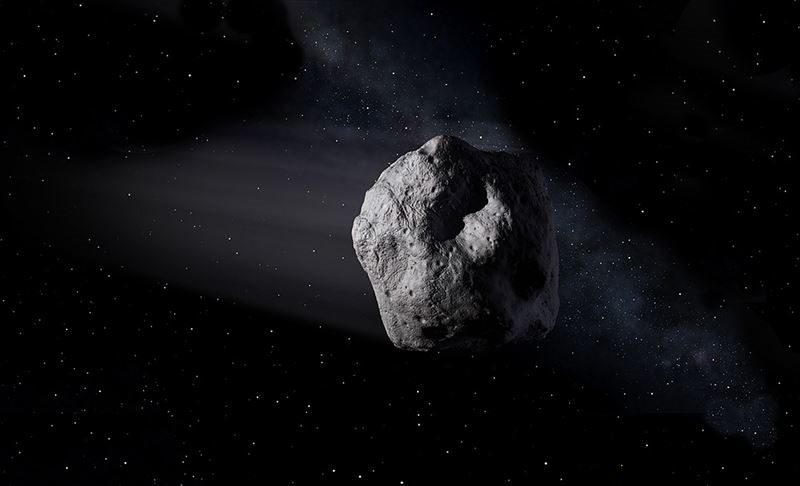
In 2022, a NASA spacecraft intentionally barreled into the tiny asteroid Dimorphos during a planetary defense test. The objective was to assess whether humanity could protect Earth from cosmic threats, such as space rocks. New observations now reveal that the planetary defense test was a success, altering the orbit of Dimorphos as well as that of a larger asteroid called Didymos.
Dimorphos and Didymos are a binary pair, meaning that the asteroids orbit one another while also circling the sun — and a measurable change for one will affect the other.
The new data show that the time required for Didymos and Dimorphos to complete one solar orbit, which takes about 770 days, permanently decreased by less than a second after the Double Asteroid Redirection Test, or DART, according to a study that published Friday in the journal Science Advances.
“The change in the binary system’s orbital speed was about 11.7 microns per second, or 1.7 inches per hour,” said lead study author Dr. Rahil Makadia, a planetary defense scientist who worked on the DART team and recently completed his PhD in aerospace engineering at the University of Illinois Urbana-Champaign, in a statement. “Over time, such a small change in an asteroid’s motion can make the difference between a hazardous object hitting or missing our planet.”
The DART mission marks the first time a human-crafted object has altered the path of a celestial body as it orbits the sun, according to the study authors — and if an asteroid is found to be on a collision course with Earth in the future, it may not be the last time.